-
×
 Première Rhapsodie
1 × 40,00 €
Première Rhapsodie
1 × 40,00 €
Descrição
Obra vencedora do 1º Prémio de Composição Francisco Martins (2017), organizado pela Orquestra Clássica do Centro (OCC).
Estreia mundial a 17 de Novembro de 2017, no Grande Auditório do Conservatório de Música de Coimbra, pela Orquestra Clássica do Centro e com direcção musical de José Eduardo Gomes.
Winner of the 1st Francisco Martins Composition Prize (2017), held by the Orquestra Clássica do Centro (OCC).
World premiere on November 17, 2017, at the Main Hall of the Coimbra Conservatory of Music, by the Orquestra Clássica do Centro under the musical direction of José Eduardo Gomes.
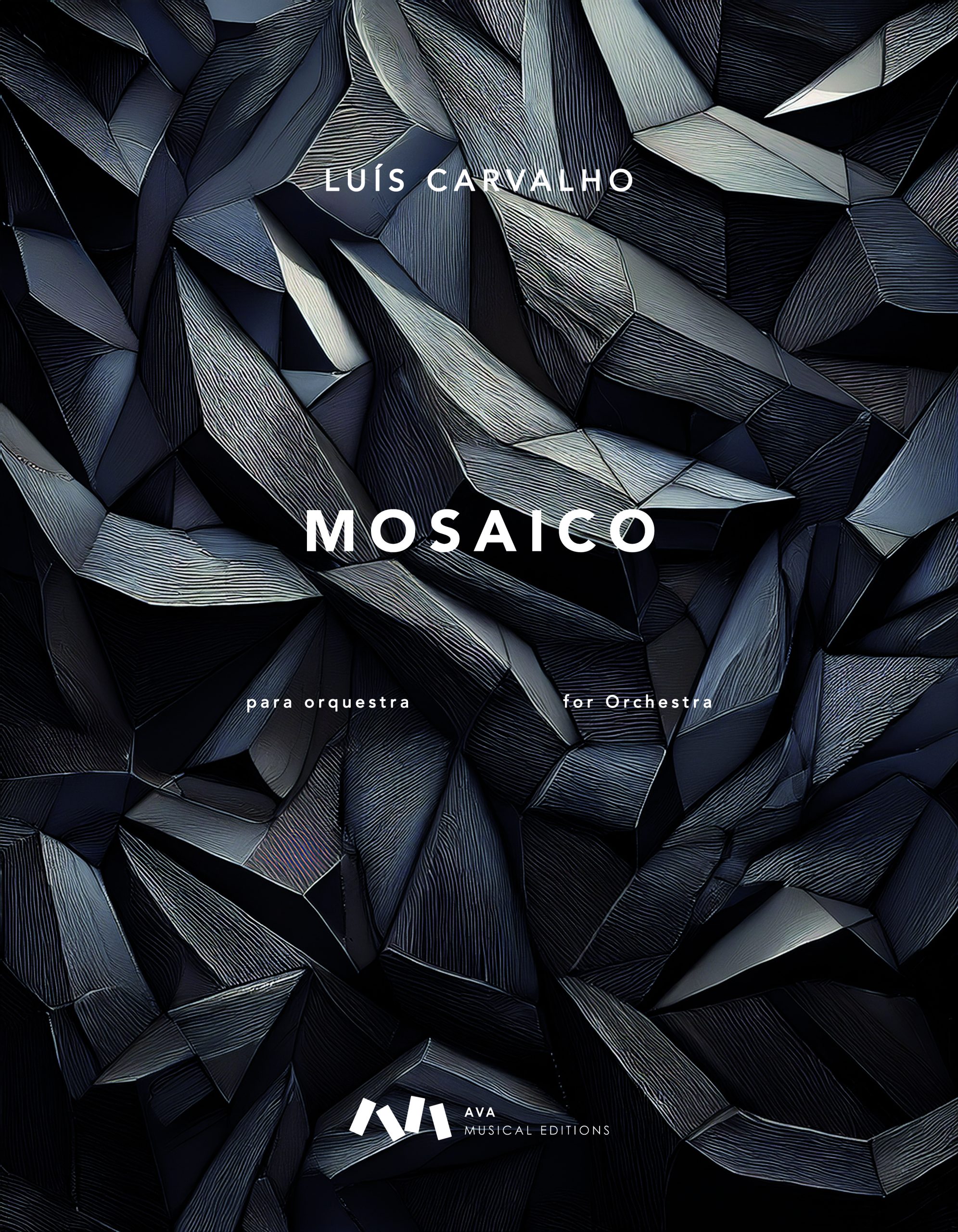
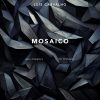
MOSAICO (ou ARTE MUSIVA) é uma técnica de arte decorativa milenar, caracterizada por um embutido de pequenas peças coloridas (tesselas), mais comummente pedras, mas também existente em outros materiais como vidro, conchas, e até plástico ou missangas. O objectivo dos mosaicos é preencher artisticamente planos como pavimentos, paredes e mesmo tectos, frequentemente com representações figurativas, sejam pessoas, paisagens ou composições geométricas. A típica calçada portuguesa bi-cromática (pedras pretas/brancas) representa uma variante muito particular desta arte musiva, decorando grandes espaços urbanos com motivos tradicionalmente geométricos.
O termo “mosaico”, apesar de ter origem etimológica obscura, derivará muito provavelmente do grego mousaikón, que significa «pertinente às Musas», portanto, «artístico». As Musas eram as divindades inspiradoras das artes e ciências na mitologia grega antiga (por exemplo, Euterpe para a música, Calíope para a poesia, Urânia para a astronomia, etc.), e acredita-se que aquele mesmo vocábulo possa também ter dado origem à palavra «música».
Na presente obra, a ideia de mosaico serve de metáfora para a construção de uma forma musical ampla (um andamento único contínuo), que deriva da conjugação de múltiplos pequenos fragmentos/motivos temáticos (correspondentes, também metaforicamente, às «tesselas» mencionadas acima). Organizada numa sucessão de secções distintas, mas complementares, a interligação das partes é garantida pela técnica da modulação métrica, que assim funciona como pivot estrutural da obra.
Do ponto de vista do discurso musical, não só horizontalmente (melodicamente) como também verticalmente (harmonicamente), todo ele é delineado com base na organização geométrica das relações intervalares, essencialmente 2as menores (meios-tons) e 2as aumentadas (ou 3as menores). No entanto, esta abordagem criativa não é assumida de forma restritiva, e outros processos composicionais são integrados harmoniosamente no discurso, concretizando, espera-se, um objecto artístico diversificado, mas coerente.
MOSAICO (Mosaic) is a millenarian decorative art technique, characterized by the assemblage of small coloured pieces (tesselas), most commonly stones, but existing also in other materials such as glass, shells, and even plastic or beads. The aim of mosaics is to fill surfaces artistically, such as floors, walls, and even ceilings. Their depictions are often figurative, representing people, landscapes, or geometric compositions. The traditional bi-chromatic Portuguese pavement (calçada portuguesa), usually made of black and white stones, represents a particularly distinctive variant of this art form, decorating large urban spaces with predominantly geometric patterns.
The word mosaic, despite its obscure etymological origin, most probably derives from the Greek mousaikón, meaning “belonging to the Muses”, and therefore “artistic”. The Muses were the inspirational deities of the arts and sciences in Ancient Greek mythology (for example, Euterpe for music, Calliope for poetry, Urania for astronomy, etc.), and it is believed that the same root may also have given rise to the word music.
In the present work, the idea of a mosaic serves as a metaphor for the construction of a broad musical form (a single continuous movement), derived from the combination of multiple short thematic fragments or motifs (which correspond, metaphorically, to the tesselas mentioned above). Organized as a succession of distinct yet complementary sections, the continuity between the parts is ensured through the technique of metric modulation, which functions as the structural pivot of the work.
From the standpoint of musical discourse, both horizontally (melodically) and vertically (harmonically), the material is shaped according to the geometric organization of intervallic relationships, primarily minor seconds (semitones) and augmented seconds (or minor thirds). Nevertheless, this compositional approach is not applied restrictively, and other creative processes are integrated naturally into the musical discourse, resulting, it is hoped, in an artistic work that is both diverse and coherent.
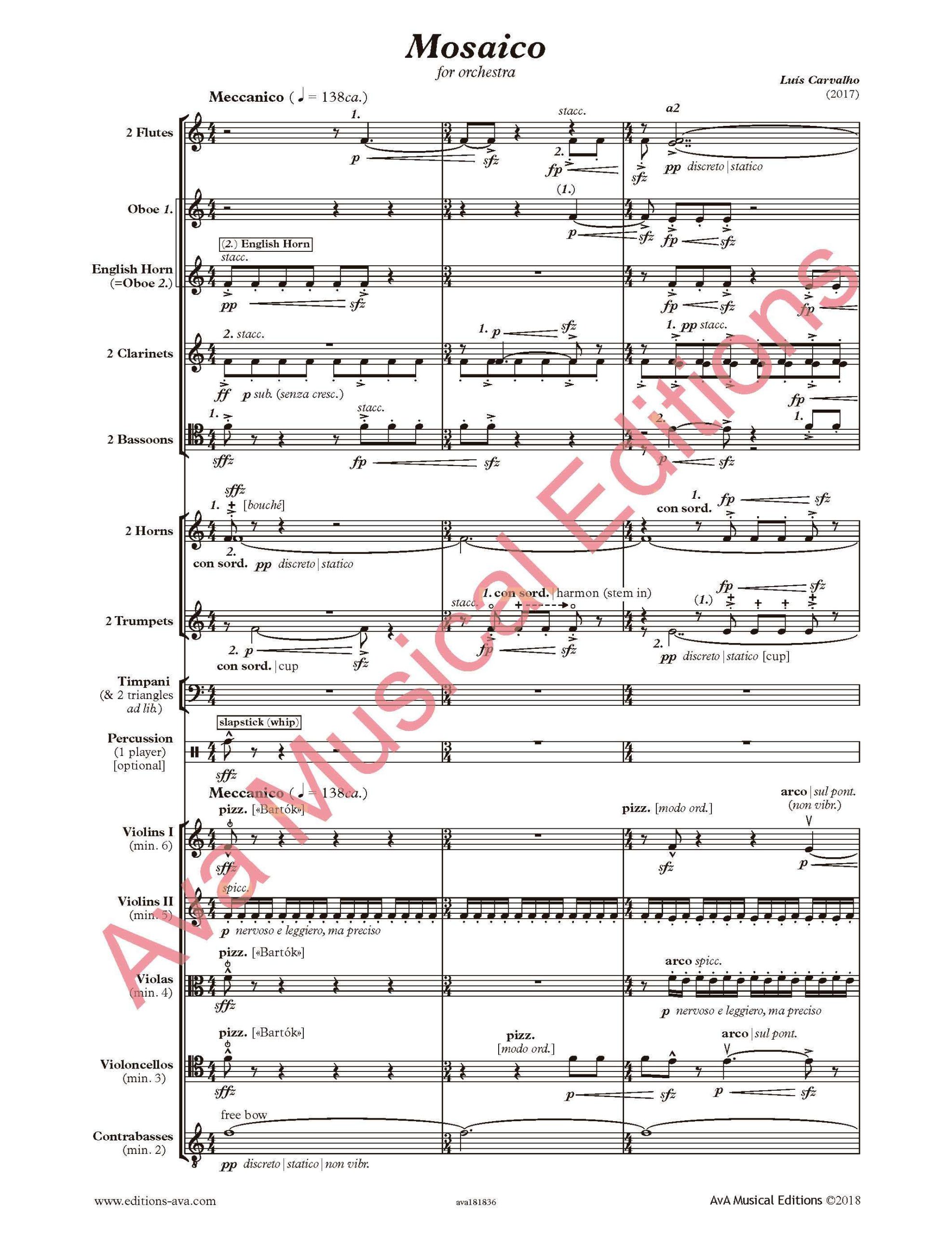
Instrumentation
2 Flutes
(2. doubles Piccolo)
2 Oboes
(2. doubles English-horn in F)
2 Clarinets
(1. in B♭ / 2. in A & Bass-clarinet in B♭)
2 Bassoons
2 Horns in F
2 Trumpets in C
Timpani (& 2 triangles ad libitum)
Percussion (1 player) [optional]
slapstick [whip]; 2 suspended cymbals [large/medium];
cymbals a2; sizzle cymbal; floor-drum [no snares]; snare-drum;
wood block [medium]; temple block [medium]; tambourine;
güiro; triangle [small (high pitch) | suspended]
Violins I (min. 6 | max. 8)
Violins II (min. 5 | max. 8)
Violas (min. 4 | max. 6)
Violoncellos (min. 3 | max. 6)
Contrabasses (min. 2 | max. 4)
* Triangles assigned to the timpanist [1. small (high pitch) | 2. big (low pitch)], must be suspended and are to be played whenever the optional percussionist is used, as they interact with the percussion part; otherwise, when playing only with timpanist, triangles are facultative.
dur.: ca. 11 min.
Score in C
all instruments sound as written,
except for octave transposing instruments
[i.e., Piccolo and Contrabasses]
Informação adicional
| Peso | 1400 g |
|---|---|
| Tipo | Partitura completa, Aluguer das partes de orquestra (valor sob consulta) |
| Compositor | |
| Instrumento | Percussão, Trompa I, Trompa II, Trompete I, Trompete II, Viola, Violoncelo, Clarinete Baixo, Clarinete I, Clarinete II, Contrabaixo, Corne Inglês, Fagote I, Fagote II, Flauta I, Flauta II, Flautim / Piccolo, Oboé I, Oboé II, Tímpanos, Violino I, Violino II |
| Tipologia | |
| Duração |
Autor
Luís Carvalho (1974)
Saiba maisProdutos Relacionados

Price range: 50,00 € through 250,00 € IVA incl.
This product has multiple variants. The options may be chosen on the product page

Price range: 20,00 € through 45,00 € IVA incl.
This product has multiple variants. The options may be chosen on the product page

Price range: 0,00 € through 70,00 € IVA incl.
This product has multiple variants. The options may be chosen on the product page

Price range: 0,00 € through 40,00 € IVA incl.
This product has multiple variants. The options may be chosen on the product page
Mais vendidosVer mais
Price range: 0,00 € through 40,00 € IVA incl.
This product has multiple variants. The options may be chosen on the product page