-
×
 Pacificando o revoltado
1 × 7,00 €
Pacificando o revoltado
1 × 7,00 € -
×
 Compositores Portugueses - Repertório para Pianistas Volume IV
1 × 28,00 €
Compositores Portugueses - Repertório para Pianistas Volume IV
1 × 28,00 €



Descrição
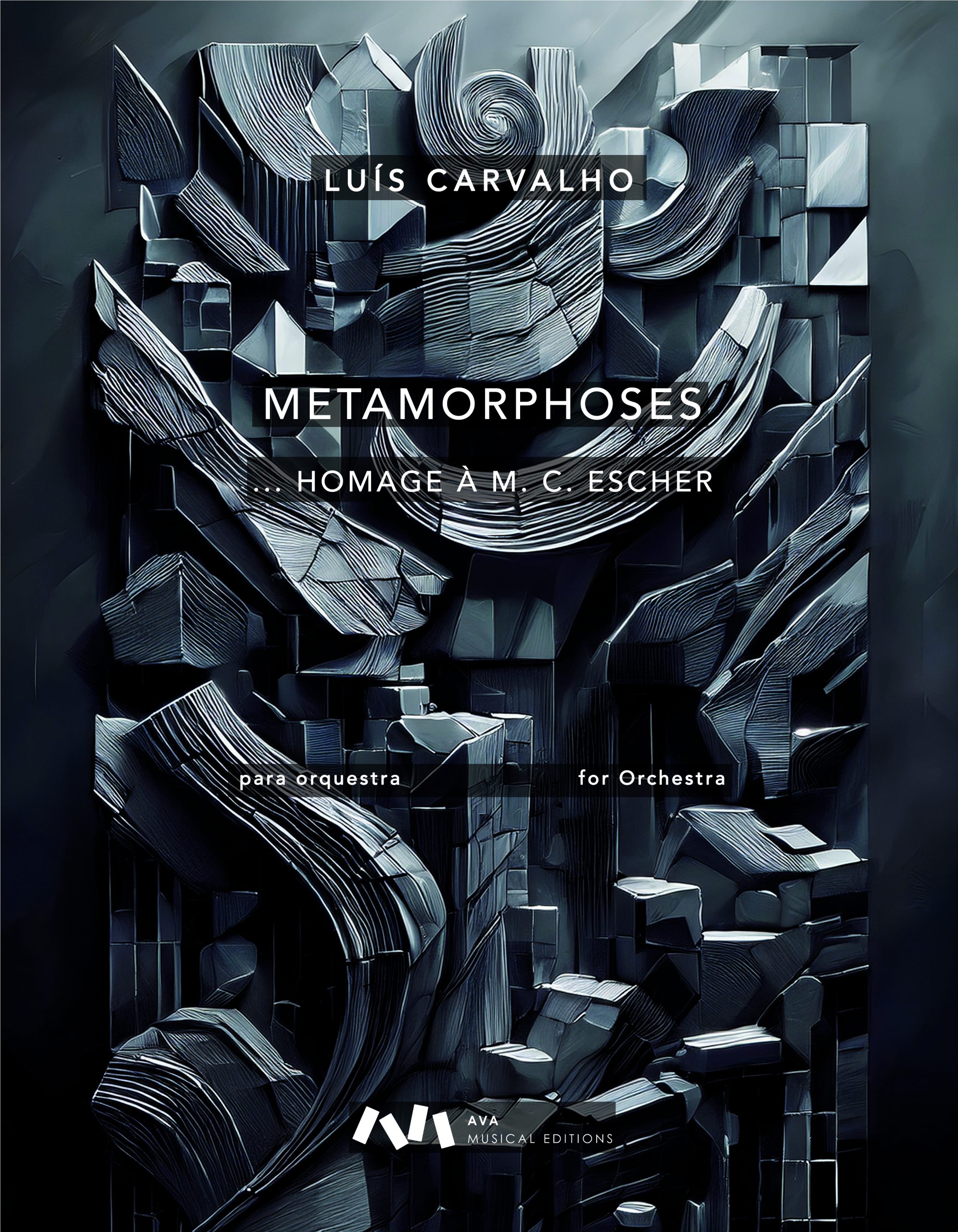
Metamorphoses… homage à M. C. Escher (2009)
para orquestra
O universo gráfico de Maurits Cornelius Escher (1898–1972, mais conhecido como M. C. Escher) sempre exerceu em mim um enorme e duradouro fascínio pela forma como concilia a imaginação fantástica com um rigor técnico quase matemático. Em particular, as suas célebres sequências Metamorphosis I, II e III apresentam um mundo onde a clareza do discurso visual emerge de um perfeccionismo intrínseco absoluto, resultando num continuum plástico onde formas distintas (e algumas até aparentemente inconciliáveis) se fundem e transformam sem ruturas.
Nesta minha homenagem orquestral ao grande gravurista neerlandês, o conceito de «metamorfose» é transposto para o domínio da música através da técnica da variação contínua. A obra estrutura-se numa sucessão de secções interligadas – diferentes “mundos” de Escher – que partilham uma ideia germinal comum. Motivos melódicos, células rítmicas e campos harmónicos recorrentes funcionam como os polígonos de Escher: elementos que, ao serem manipulados, dão origem a novas figuras sem nunca perderem a sua matriz genética original.
Invocando o aforismo ma fin est mon commencement, e tal como Escher retorna à imagem inicial após as inúmeras “metamorfoses”, também a minha composição propõe uma viagem linear e orgânica que torna ao ponto de partida. Aqui, o processo de variação não é um fim em si mesmo, mas o motor para uma experiência sensorial que procura refletir a fluidez das gravuras do neerlandês. O objetivo último é a comunicação com o ouvinte, convidando-o a percorrer uma arquitetura de sons tão intrigante e cativante quanto as impossíveis geometrias de Escher.
Obra vencedora do 2º Prémio no 4º Concurso Internacional de Composição da Póvoa de Varzim (2009), organizado pelo Festival Internacional de Música da Póvoa de Varzim (Portugal).
Metamorphoses… homage à M. C. Escher (2009)
for orchestra
The graphic universe of Maurits Cornelius Escher (1898–1972, better known as M. C. Escher) has always exerted a profound and lasting fascination on me, due to the way it reconciles a fantastic imagination with almost mathematical technical rigour. In particular, his celebrated sequences Metamorphosis I, II and III present a world where the clarity of visual discourse emerges from an absolute intrinsic perfectionism, resulting in a plastic continuum where distinct – and sometimes seemingly irreconcilable – forms merge and transform seamlessly.
In this orchestral tribute to the great Dutch printmaker, the concept of “metamorphosis” is transposed to the musical domain through the technique of continuous variation. The work is structured as a succession of interconnected sections – Escher’s various “worlds” – which share a common germinal idea. Recurring melodic motifs, rhythmic cells, and harmonic fields function like Escher’s polygons: elements that, when manipulated, give rise to new figures without ever losing their original genetic matrix.
Invoking the aphorism ma fin est mon commencement, and just as Escher returns to the initial image after countless “metamorphoses”, my composition proposes a linear and organic journey that eventually returns to its starting point. Here, the process of variation is not an end in itself, but the engine for a sensory experience that seeks to reflect the fluidity of the Dutchman’s engravings. The ultimate goal is communication with the listener, inviting them to traverse a sound architecture as intriguing and captivating as Escher’s impossible geometries.
Award-winning piece: 2nd Prize at the 4th Póvoa de Varzim International Composition Competition (2009), organized by the Póvoa de Varzim International Music Festival (Portugal).
Orchestra:
2 Flutes
(2. also Piccolo)
2 Oboes
(2. also English Horn in F)
2 Clarinets
(1. in A & B♭ / 2. in B♭ & Bass Clarinet in B♭)
2 Bassoons
(2. also Contrabassoon)
2 Horns (in F)
2 Trumpets (in C)
Timpani
Percussion*
Violins I (min. 6)
Violin II (min. 5)
Violas (min. 4)
Violoncellos (min. 4)
Contrabasses (min. 2)
Percussion instruments required (1 player):
3 suspended cymbals (large / medium / small); sizzle cymbal (suspended);
2 triangles (small [high] / big [low] – attached to tripod); tambourine (big);
very high bongoe; wind chimes; glockenspiel; vibraphone.
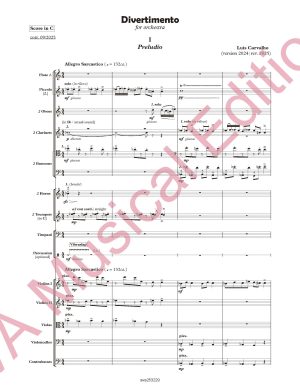
Score in C
all instruments sound as written,
except for octave transposing instruments
dur.: ca. 10 min.
Informação adicional
| Peso | n.d. |
|---|---|
| Compositor | |
| Instrumento | Percussão I, Trompa I, Trompa II, Trompete I, Trompete II, Viola, Violoncelo, Clarinete Baixo, Clarinete I, Clarinete II, Contrabaixo, Corne Inglês, Fagote I, Fagote II, Flauta I, Flauta II, Oboé I, Oboé II, Tímpanos, Violino I, Violino II |
| Duração | |
| Tipologia | |
| Tipo | Partitura, Aluguer das partes de orquestra (valor sob consulta) |
Autor
Luís Carvalho (1974)
Saiba maisProdutos Relacionados

Price range: 0,00 € through 80,00 € IVA incl.
This product has multiple variants. The options may be chosen on the product page

Price range: 0,00 € through 30,00 € IVA incl.
This product has multiple variants. The options may be chosen on the product page


Price range: 20,00 € through 45,00 € IVA incl.
This product has multiple variants. The options may be chosen on the product page
Price range: 0,00 € through 80,00 € IVA incl.
This product has multiple variants. The options may be chosen on the product page


Price range: 0,00 € through 80,00 € IVA incl.
This product has multiple variants. The options may be chosen on the product page

Price range: 0,00 € through 40,00 € IVA incl.
This product has multiple variants. The options may be chosen on the product page
Mais vendidosVer mais
Price range: 0,00 € through 40,00 € IVA incl.
This product has multiple variants. The options may be chosen on the product page